Cylinder
Volume of Cylinder
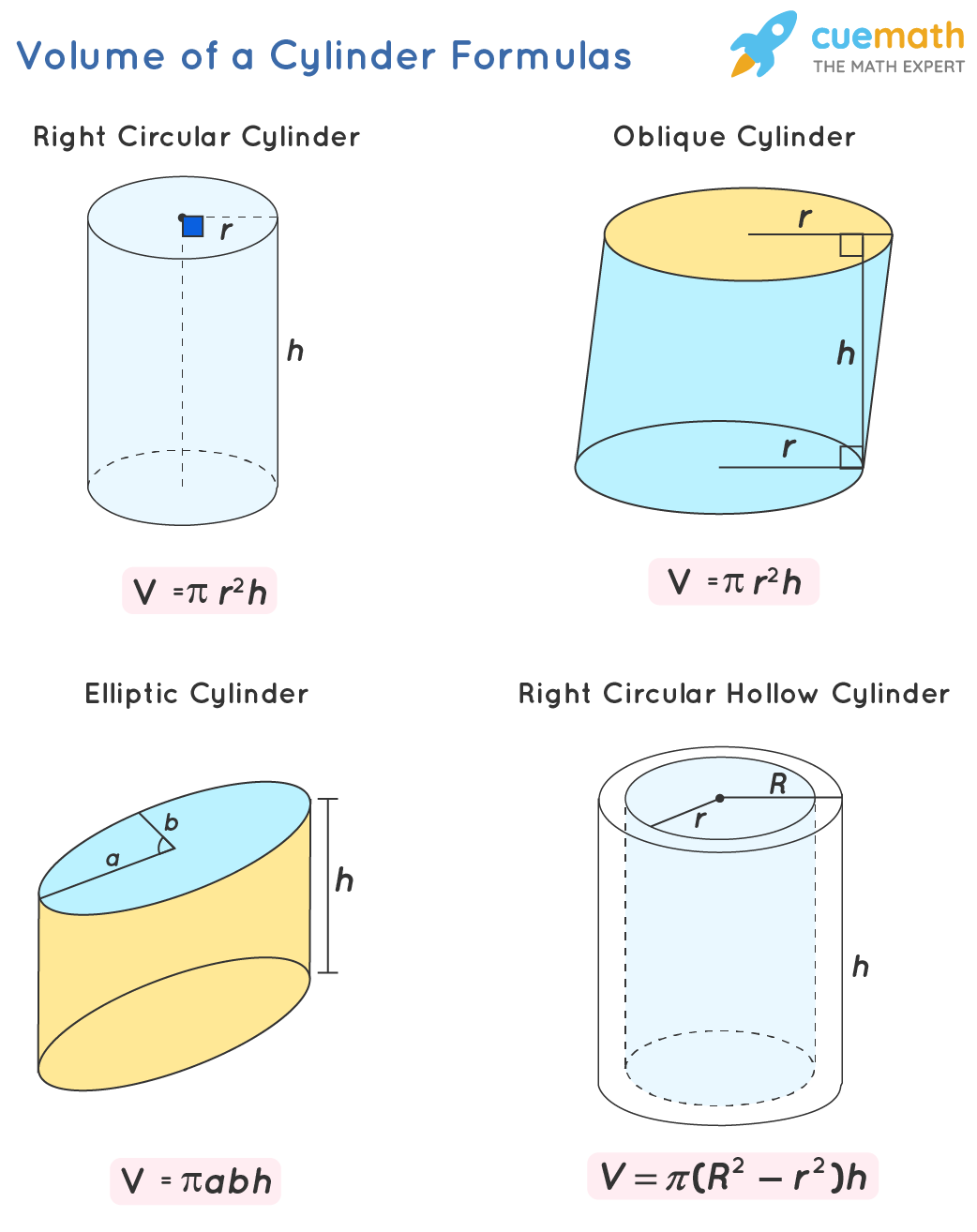
The volume of a cylinder is the capacity of the cylinder which calculates the amount of material quantity it can hold. In geometry, there is a specific volume of a cylinder formula that is used to measure how much amount of any quantity whether liquid or solid can be immersed in it uniformly. A cylinder is a three-dimensional shape with two congruent and parallel identical bases. There are different types of cylinders. They are:
- Right circular cylinder: A cylinder whose bases are circles and each line segment that is a part of the lateral curved surface is perpendicular to the bases.
- Oblique Cylinder: A cylinder whose sides lean over the base at an angle that is not equal to a right angle.
- Elliptic Cylinder: A cylinder whose bases are ellipses.
- Right circular hollow cylinder: A cylinder that consists of two right circular cylinders bounded one inside the other.
Volume of a Cylinder
The volume of a cylinder is the number of unit cubes (cubes of unit length) that can be fit into it. It is the space occupied by the cylinder as the volume of any three-dimensional shape is the space occupied by it. The volume of a cylinder is measured in cubic units such as cm3, m3, in3, etc. Let us see the formula used to calculate the volume of a cylinder.
Definition of a Cylinder
A cylinder is a three-dimensional solid shape that consists of two parallel bases linked by a curved surface. These bases are like a circular disk in a shape. The line passing from the center or joining the centers of two circular bases is called the axis of the cylinder.
Volume of Cylinder Formula
We know that a cylinder resembles a prism (but note that a cylinder is not a prism as it has a curved side face), we use the same formula of volume of a prism to calculate the volume of a cylinder as well. We know that the area of a prism is calculated using the formula,
V = A × h, where
- A = area of the base
- h = height
Now we will apply this formula to calculate the volume of different types of cylinders.
Volume of a Right Circular Hollow Cylinder
As a right circular cylinder is a cylinder that consists of two right circular cylinders bounded one inside the other, its volume is obtained by subtracting the volume of the inside cylinder from that of the outside cylinder. Thus, the volume (V) of a right circular hollow cylinder is,
V = π(R2 - r2)h
Here,
- 'R' is the base radius of the outside cylinder.
- 'r' is the base radius of the inside cylinder.
- 'h' is the height of the cylinder.
- π is a constant whose value is either 22/7 (or) 3.142.
How To Calculate the Volume of Cylinder?
Here are the steps to calculate the volume of cylinder:
- Identify the radius to be 'r' and height to be 'h' and make sure that they both are of the same units.
- Substitute the values in the volume formula V = πr2h.
- Write the units as cubic units.
Example: Find the volume of a right circular cylinder of radius 50 cm and height 1 meter. Use π = 3.142.
Solution:
The radius of the cylinder is, r = 50 cm.
Its height is, h = 1 meter = 100 cm.
Its volume is, V = πr2h = (3.142)(50)2(100) = 785,500 cm3.
Note: We need to use the formula to find the volume of a cylinder depending on its type as we discussed in the previous section. Also, assume that a cylinder is a right circular cylinder if there is no type given and apply the volume formula to be V = πr2h
Comments
Post a Comment