Square root
In mathematics, a square root of a number x is a number y such that y2 = x; in other words, a number y whose square (the result of multiplying the number by itself, or y ⋅ y) is x.[1] For example, 4 and −4 are square roots of 16, because 42 = (−4)2 = 16. Every nonnegative real number x has a unique nonnegative square root, called the principal square root, which is denoted by where the symbol is called the radical sign[2] or radix. For example, the principal square root of 9 is 3, which is denoted by because 32 = 3 ⋅ 3 = 9 and 3 is nonnegative. The term (or number) whose square root is being considered is known as the radicand. The radicand is the number or expression underneath the radical sign, in this case 9.


Every positive number x has two square roots: which is positive, and which is negative. Together, these two roots are denoted as (see ± shorthand). Although the principal square root of a positive number is only one of its two square roots, the designation "the square root" is often used to refer to the principal square root. For positive x, the principal square root can also be written in exponent notation, as x1/2.[3][4]


Square roots of negative numbers can be discussed within the framework of complex numbers. More generally, square roots can be considered in any context in which a notion of the "square" of a mathematical object is defined. These include function spaces and square matrices, among other mathematical structures.
Properties and uses

The principal square root function 
The square root of x is rational if and only if x is a rational number that can be represented as a ratio of two perfect squares. (See square root of 2 for proofs that this is an irrational number, and quadratic irrational for a proof for all non-square natural numbers.) The square root function maps rational numbers into algebraic numbers, the latter being a superset of the rational numbers).
For all real numbers x,
(see absolute value)
For all nonnegative real numbers x and y,
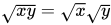
and

The square root function is continuous for all nonnegative x, and differentiable for all positive x. If f denotes the square root function, whose derivative is given by:
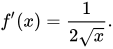
The Taylor series of 

The square root of a nonnegative number is used in the definition of Euclidean norm (and distance), as well as in generalizations such as Hilbert spaces. It defines an important concept of standard deviation used in probability theory and statistics. It has a major use in the formula for roots of a quadratic equation; quadratic fields and rings of quadratic integers, which are based on square roots, are important in algebra and have uses in geometry. Square roots frequently appear in mathematical formulas elsewhere, as well as in many physical laws.
Comments
Post a Comment