Trigonometry
Trigonometry (from Greek trigonon "triangle" + metron "measure")
Want to learn Trigonometry? Here is a quick summary.
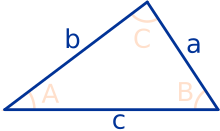 | Trigonometry ... is all about triangles. |
Trigonometry helps us find angles and distances, and is used a lot in science, engineering, video games, and more!
Right-Angled Triangle
The triangle of most interest is the right-angled triangle. The right angle is shown by the little box in the corner:
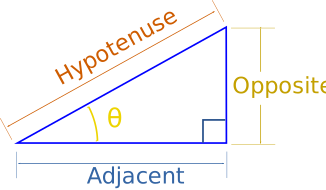
Another angle is often labeled θ, and the three sides are then called:
- Adjacent: adjacent (next to) the angle θ
- Opposite: opposite the angle θ
- and the longest side is the Hypotenuse
Why a Right-Angled Triangle?
Why is this triangle so important?
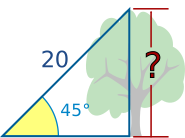
Imagine we can measure along and up but want to know the direct distance and angle:
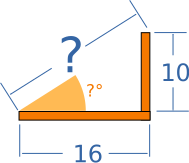
Trigonometry can find that missing angle and distance.
Or maybe we have a distance and angle and need to "plot the dot" along and up:
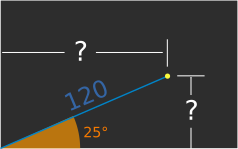
Questions like these are common in engineering, computer animation and more.
And trigonometry gives the answers!
Sine, Cosine and Tangent
The main functions in trigonometry are Sine, Cosine and Tangent
They are simply one side of a right-angled triangle divided by another.
For any angle "θ":
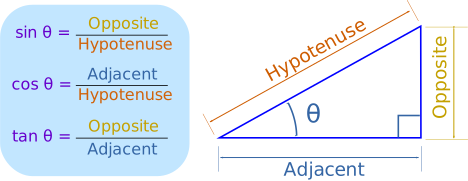
(Sine, Cosine and Tangent are often abbreviated to sin, cos and tan.)
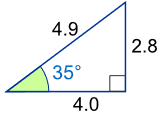
The triangle could be larger, smaller or turned around, but that angle will always have that ratio.
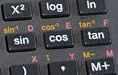
Calculators have sin, cos and tan to help us, so let's see how to use them:
Comments
Post a Comment